

Everyday object shorts generator
ViewGum's Object Lesson makes narrated shorts about the true story of one everyday object for YouTube Shorts, TikTok and Instagram Reels. Name a real thing, such as the banana in your kitchen, and the whole story happens to it, in photo-style pictures made by AI for the story, with captions, music and sound effects. An Object Lesson short runs 45 to 90 seconds; 45 seconds costs 400 to 500 credits, export included. You export one MP4 with post copy for each app and post it yourself.
Object Lesson shorts at a glance
- Length
- 45 to 90 seconds, in 15-second steps; about 45 seconds unless you pick another. A short lands within a fifth of the length you pick.
- In each short
- A narrator voice, and one real thing the whole story happens to, in photo-style places made for it. Captions, music and sound effects.
- Export
- One vertical 1080 x 1920 MP4 at 30 frames a second, with post copy for YouTube Shorts, TikTok, Instagram Reels and Facebook Reels. No watermark.
- Credits
- 45 seconds: 400 to 500 credits to make, export included. 90 seconds: 600 to 700 credits to make, export included.Quoted on ViewGum's default writer on November 13, 2026.
- From an AI assistant
- Yes, through ViewGum's connector, which quotes the price first.
How to make an Object Lesson short
- Name one real thing, such as table salt, or pick one of the ideas ViewGum suggests.
- Pick Object Lesson and about how long it runs, 45 to 90 seconds.
- ViewGum writes the script, checks each fact, makes the pictures, narrates it and renders the short. Watch it, then export the MP4.
Example Object Lesson shorts
Why apples go rotten
Object Lesson, 47 seconds, made November 6, 2026
An apple keeps breathing after it is picked, gives off a gas that ripens the banana beside it, and is finished by mold through a bruise.
Typed: “Why do apples go rotten?”
Make one like thisWhat the narrator says
The apple in your fruit bowl is still alive, and slowly eating itself.
Even off the tree, its cells keep breathing, burning the sugar stored inside.
No tree is sending more, so it runs down, like a phone nobody ever charges.
As it ripens, it breathes out ethylene, a gas that tells fruit to ripen faster.
The gas drifts onto the banana beside it, and it browns too. One bad apple, literally.
Its flesh goes soft. One small bruise breaks the cells open under the skin.
Mold spores are common in ordinary kitchen air. They can land on the bruise and start eating the apple.
The mold leaks out chemicals that digest the apple from the inside, turning it into soft brown mush.
Rot is nature recycling. Cold slows the breathing and the mold, so your fridge buys you weeks.
So an apple rarely just goes rotten. Usually something eats it. Itself, the mold, or, if you are quick, you.
Facts and sources (10)
- Apples are still living tissue after they are picked and keep respiring, taking in oxygen and giving off carbon dioxide.Postharvest physiology, plant science textbooks
- Respiration in a picked apple uses up the sugars stored in its flesh, and the tree no longer replaces them.Postharvest physiology, plant science textbooks
- Ripening apples give off ethylene, a plant hormone gas that speeds up ripening.Plant physiology textbooks
- Ethylene from apples can speed up ripening of other fruit stored nearby, such as bananas.Postharvest handling guides, university agricultural extension services
- As an apple ripens its flesh softens, and a bruise crushes the cells under the skin.Postharvest physiology, plant science textbooks
- Mold spores are common in ordinary indoor air.Microbiology; US Environmental Protection Agency guidance on mold
- Rot molds such as blue mold usually infect apples through bruises and wounds in the skin.Plant pathology, university agricultural extension services
- Rot fungi release enzymes that break down fruit tissue, turning it soft and brown.Plant pathology and mycology textbooks
- Decomposers such as fungi break down dead plant material and return its nutrients to the soil.Ecology textbooks
- Cold storage slows an apple's respiration and the growth of mold, so apples keep for weeks longer in a refrigerator than on a counter.USDA FoodKeeper; postharvest storage guides
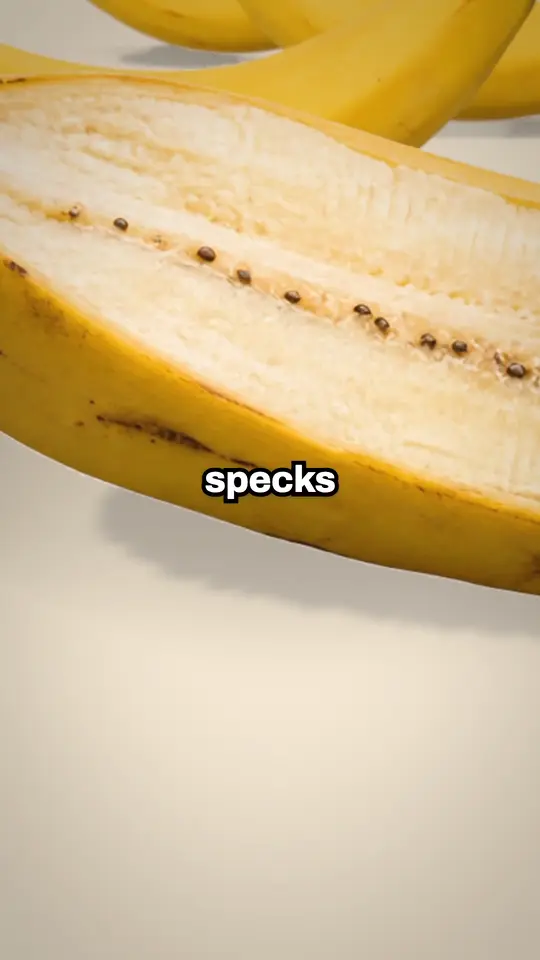
Why the banana in your kitchen is a clone
A sliced Cavendish banana, close up: the tiny black specks inside are seeds that never grew. A muted excerpt.
Make one like this
What does an Object Lesson short look like?
- One real thing is the lead. It is in nearly every shot, and everything the narrator says happens to it or because of it.
- Nobody is on screen: no presenter, no faces, no drawn eyes. The camera stands in for you, and things land on it, fog it or knock it.
- The pictures look like photographs, made by AI for the story and set on a moving 3D stage, with something near the lens and the place far behind.
- The narrator talks to you, fast and dry, one true fact at a time, each caused by the last.
- The reason is a picture: as it is said, the camera goes inside the thing or pulls back to show how big it gets.
- The last line flips the first, and the last frame matches the first with one thing changed, so the short loops.
Who Object Lesson is for
- Science and everyday-history channels: where a food, a material, a medicine or a household thing came from.
- Channels that answer why something you own is the way it is.
- Creators who want a faceless short that looks like photographs rather than a cartoon.
What Object Lesson doesn't do
- An Object Lesson short runs 45 to 90 seconds.
- No people are drawn or shown. A real person in the story is named only in the narration.
- Its pictures are made by AI to look like photographs. It uses no real footage or archive photos.
- It needs one thing with a surprising past. A story about people fits Flat world better.
- It does not post for you. You get the MP4 and post copy for each app, then post it yourself.
- It does not cut clips from long recordings.
- It does not export horizontal or square video.
- It does not have a public REST API. AI assistants connect through its MCP server.
What do the platforms say about labeling photo-style AI shorts?
- RealisticAI-made or altered content is what YouTube asks creators to disclose; content that isn't realistic needs no labelAs of October 18, 2026, source 1
- Realistic AI contentneeds a label on TikTok, which also asks for one on anything completely generated or significantly edited by AIAs of October 18, 2026, source 2
- Photorealistic videoor realistic-sounding audio that was digitally created or altered is what Meta asks you to label on Instagram and FacebookAs of October 18, 2026, source 3
An Object Lesson short is made of photo-style AI pictures with an AI narrator voice, and it carries no ViewGum watermark. Check each platform's rule for realistic AI content before you post it unlabeled.
Other ways to tell a true story
- AI cartoon story video makerViewGum
Flat world: a true story about people, acted out by flat cartoon figures in a lit 3D world.
- AI history shorts generatorViewGum
Which look fits which history story, with the facts kept true.
Questions
Is an Object Lesson short real footage?
No. Every picture in an Object Lesson short is made by AI for the story, to look like a photograph, and set on a moving 3D stage. No real footage, archive photo or real person's picture is used.
What makes a good topic for an Object Lesson short?
One real thing with a documented, surprising past: a food, a material, a medicine or an animal you have met. Ideas ViewGum suggests include "The aspirin in your drawer started as a tree", "How a mosquito finds you in the dark" and "The vanilla in your ice cream is pollinated by hand".
Do I need to label an Object Lesson short as AI?
Because its pictures look like photographs, the platforms' rules for realistic AI content may apply. YouTube asks creators to disclose realistic AI-made content (YouTube Help, checked October 18, 2026), and TikTok asks for a label on realistic AI content (TikTok Help, checked October 18, 2026). Whether a short needs one is your call under each platform's rules.
How much does an Object Lesson short cost?
On ViewGum's default writer: 45 seconds: 400 to 500 credits to make, export included; 90 seconds: 600 to 700 credits to make, export included. Creator is $49 a month for 4,500 credits, Pro is $99 a month for 9,500 credits and Studio is $199 a month for 20,000 credits. Every Object Lesson short shows its price in credits before it starts and is charged what it used, never more than the top of its range.
Can I make an Object Lesson short from my AI assistant?
Yes. Connect ViewGum to your AI assistant once, then ask it for an Object Lesson short on your topic. It shows you the price and waits for your yes before anything is charged.
Make your first Object Lesson short
Name one everyday thing, pick Object Lesson, and watch its story happen to it.
Start freeSign in with Google. New accounts get bonus credits to start.
Sources
- Disclosing use of altered or synthetic content, YouTube Help
- About AI-generated content, TikTok Help
- Labeling AI-generated images on Facebook, Instagram and Threads (February 6, 2024, updated April 1, 2025), Meta Newsroom
Last updated November 10, 2026.